It’s quiet now. I live on the site of an old hospital; my apartment is next to the main ward. My door is open and a sea breeze is blowing in a salty, soporific scent- a mixture of sea beet from the nearby cliffs, and lavender from the gardens of Vale Square. The latter is early, but unmistakable; the Victorians planted it when they created the gardens there. They adored the idea of a sensory garden- one that engaged your nose, as well as your eyes. The whole town was built on chalk. Lavender thrives on it. It was the hottest day of the year yesterday and the resulting aroma has taken me back to those quiet, warm days when I stalked Grove Ferry for late summer perch. The countryside there had once been a giant lavender farm and the plant lingers.
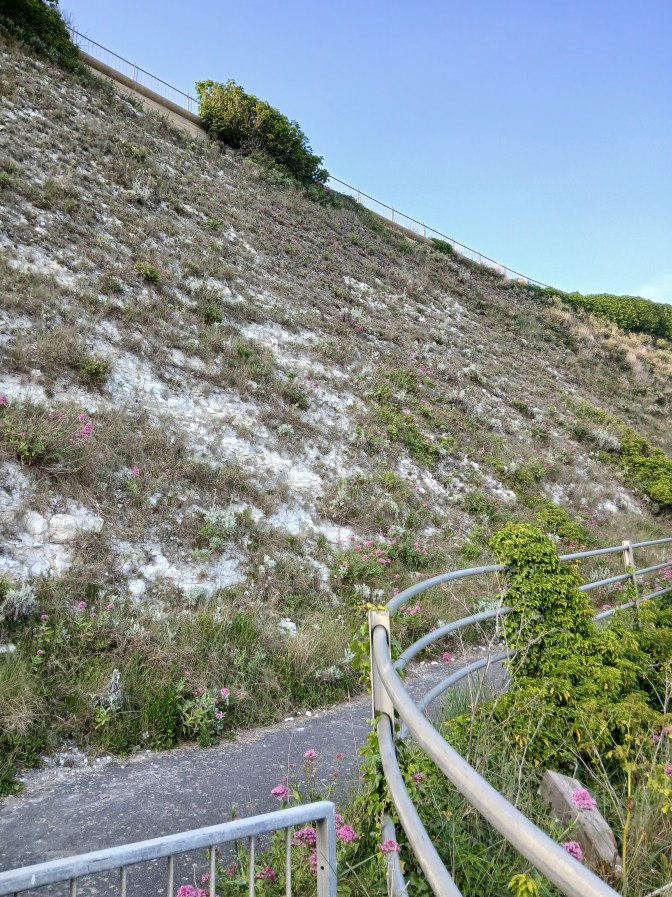
But the beet brings me back to the coast; it grows all over the local chalk cliffs. I’m tired today, but I must stay awake: I’m hosting a dinner party in just a couple of hours. Thankfully, the breeze and the beet are proving an apt countermeasure to the lavender. We’re high up here, thirty seconds walk from the cliff’s edge and a view across the Channel. The chalk extends from the cliffs, and underpins this corner of Kent; the landscape is interspersed with dips and dells. Some are leftover bomb craters- the area was targeted heavily by the Luftwaffe in the last war; others are actually remnants of old chalk quarries. We lived at Nethercourt before moving and there’s a huge hole in the upper portion of the estate’s park that most take to be another wartime scar; in fact, it was the local chalk pit. At the bottom of my road, there’s a Waitrose; the building it occupies is very 1970s, but the walls that surround it are old and used to belong to the Tomson and Wotton Brewery- one of England’s oldest sites for making beer. T & W used the local water- which is full of calcium- to brew their various bitters, as does Gadds, the local successor. It lends the hops a crisp snap that isn’t possible elsewhere in the country. In fact, the Waitrose site is built atop a deep underground well, that Tomson and Wotton used to help make their beer.
The chalk lives on, and every nearby living creature thrives on it, including us. Our tap water draws on it, hence why our kettles grow so crusty. And the local wildlife seems to thrive on it. My friend Andi just moved into a flat in the centre of town; the building is set deep into the ground, and the lower apartments are surrounded by subterranean chalk; it’s very nice- many of the same flowers grow there, as grow on the coastal cliffs, and consequently, it’s often visited by the same birds and butterflies.
In the past twenty hours, I’ve encountered three fellows of the chalk, all of whom I’m rather fond. The first was the Painted Lady; they migrate and mate along the cliffs of southern England every warm season. Yesterday was exceptional for them; as I walked along the western promenade in the evening, I was hard-pressed to go five yards without bumping into one. I stalked one specimen for almost fifteen minutes before getting a picture I thought worthy of sharing with you:
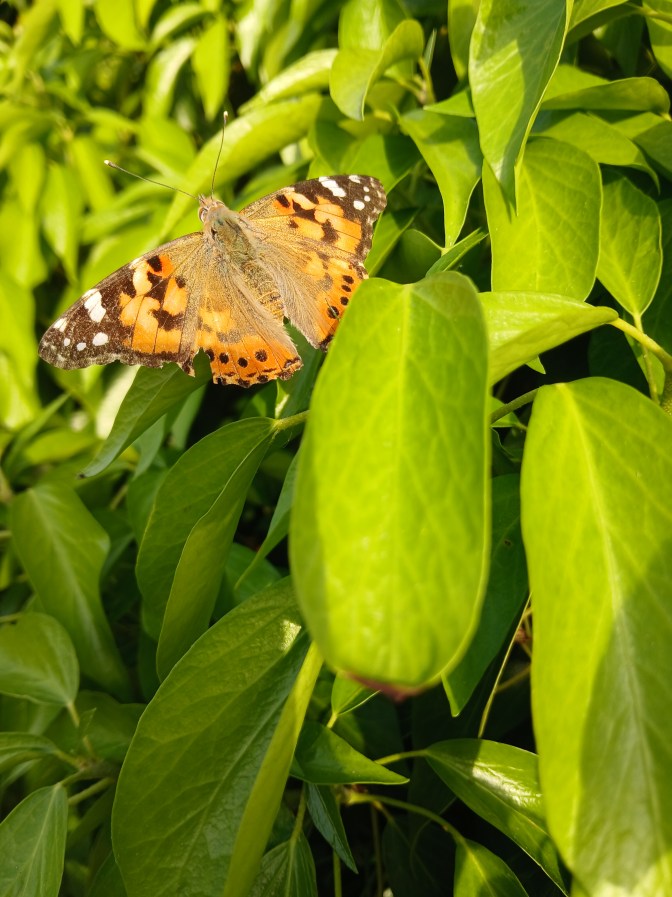
I won’t photograph one until next year now. ‘Why bother?’ some might ask, seeing as I already have so many similar snaps. Well, to answer such a cynic is easy: it’s my religion. That, along with a thousand other small rituals, help me to find my place alongside my fellow creatures of the chalk, the second of whom- the linnet- I encountered soon after bidding adieu to my fair painted lady.
The linnet is no threat to a butterfly. If anything, I would theorise that their seductive song relaxes the latter and encourages it to mate. Indeed, how could it not? The song is so utterly transfixing and primal; it’s the least self-conscious call of all the animal kingdom and comes from somewhere that us humans strive but struggle to access. Here’s one I recorded down in Pegwell:
The birds were all over the hot chalk yesterday, climbing and chortling across the cliff-face in search of dandelion and dock seeds, which is the chief reason a painted lady can co-exist so peacefully with the bird- because the latter is a committed vegetarian. It’s even in their name- ‘Linaria Cannabina’: ‘linaria’ is Latin for ‘flax’, the seeds of which the birds like to plunder, in between sounding like a Victorian music box. Speaking of Victorians, I mentioned earlier that they prized a multi-sensory experience. Well, so do I, and between the beauty of the painted ladies, the song of the linnet and the scent of the cliff’s sweet honey-musk, my subconscious mind began to regress. When this happens naturally, it’s a wonderful thing. I was recently diagnosed with epilepsy and I’ve been given all kinds of advice on the importance of switching off. I try to set aside time for this, but it’s always so much the sweeter when it occurs involuntarily, à la Proust. My Combray yesterday was Pegwell; it helped that I was there already. It helped even more that at just gone eight ‘o’ clock, I was staring down into the old tidal pool where I played so often as a child. And this is where my third and final fellow of the chalk enters my recollection: the sea bass. The bass was my first fish, and a couple of hundred yards west of here, beneath the cliff-tunnel known as ‘The Chine’, I caught my first. I was not using bait, but instead a ‘spinner’- a small metal spoon that revolves as you retrieve, imitating a prey fish. For it to work well, the water must be clear, and yesterday evening- it was.
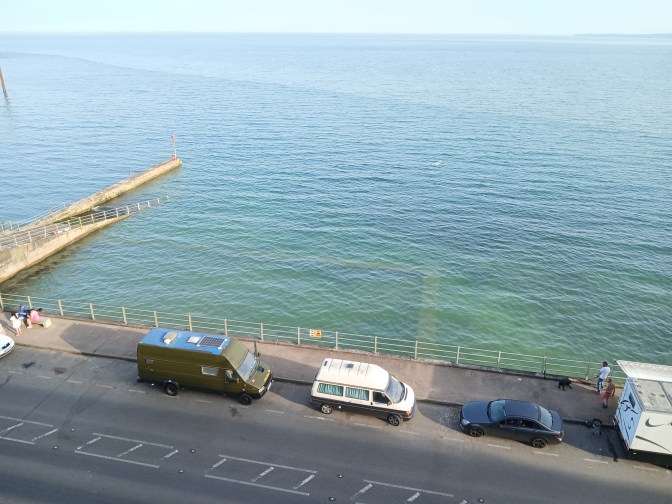
My thoughts narrowed and narrowed until I could think only of catching a bass- to boot, using the same method I used all those decades ago. The tide was on the turn, with a low water of ten to one in the next morning. I decided to go out at around eleven and fish a spot along the coast. I went home and got my lure fishing kit in order; in recent weeks, I’ve spent hours and hours thinking about doing this, but achieved nothing. Last night, in very little time at all, I set myself up for the entire season. I then took a nap, and woke up just after ten. As I walked to the bus stop, the bats were out everywhere, all over the old site; there are lots locally, thanks to a combination of Victorian rooftops and the local cliff tunnels. There is something of the bat in the bass: they’re both active at night, in the warmer months, and there’s that translucent webbing on a bass’ spiky dorsal, that so resembles a pipistrelle’s wing-span. The bus last night was full of drinkers- it’s a Bank Holiday. I was heading a little out of town, along the coast to another chalky stronghold that I sometimes visit. Bass fishermen collect secret places and alternate their visits according to a fine balance of practical consideration and abject superstition.
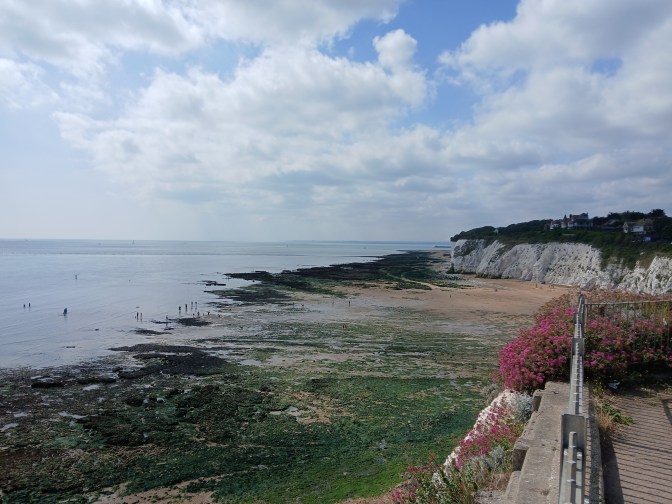
I keep my spots secret from other hunters, save for one chap- my friend Josh, with whom I’ve worked alongside these past eight years; as well as being a great pal, he’s also a fly fisher of prodigious talent. Prior to meeting Josh, I fly fished for trout a little, but more for coarse fish. Since, I’ve caught both pike and bass using his magnificent flies. Not to mention wild chalkstream trout. There’s little to match his fly-tying, which is on a par with the float making of Paul Cook and Andrew Field. But… When it comes to bass, I prefer to spin. It’s what I learned as a child, and objectively, I feel it gives me the most direct access to the fish. Last night, I was visiting a spot that can be awash with sand eels, rock gobies and and herring fry in a Kentish May.
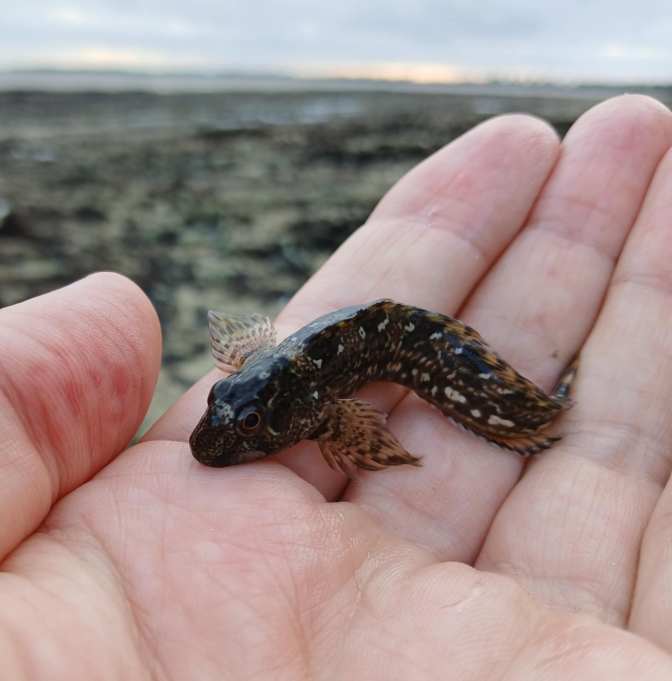
As mentioned, it was hot yesterday. On a day like that, the baitfish gather around ‘bubble-ups’- small fissures in the chalk where water is released from the deep sources below; it cools the temperature and the fish enjoy drifting near to these release-points, in the same way I wallowed about my local (and highly air-conditioned) Tesco’s, earlier today. The chalk water mentioned is the same that runs underneath Thanet. I can’t say exactly where these spots are but I’m gaining in consistency; year on year, I’ve grown used to the idiosyncrasies of the various translucent fry-tribes. They never fail to gather in the same locales- some of which have no discernible features. These seemingly barren spots must have something going for them, and in the hotter weather, I suspect it’s the deep draughts of cool ground water that comes up. Rightly or wrongly, I caught three sizeable fish within twenty minutes, one of which came in at just over four pounds. I kept them all and threw the next three back, by which point my haul was hurting my back.
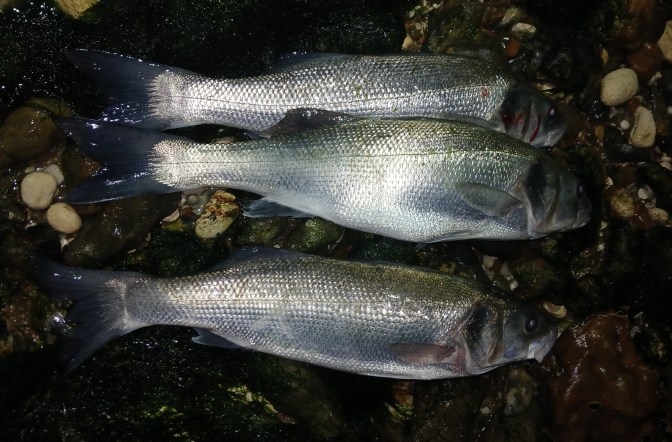
I descaled, gutted and cleaned my fish in a rockpool before walking most of the way back home. I got home at an atrocious hour; it’s not on, really. I’m supposed to be resting. Worse still, I immediately sent invitations out for this imminent grand dinner party. This meant making the aforementioned trip to Tesco, to buy champagne and parsley, and other bits. Champagne goes well with local bass, which tastes faintly of aniseed at this time of the year, when they feast so wildly on the local fry stocks. The vintage I purchased was ‘Tattinger Nocturne’; that latter word is such a fitting tribue for the bass, and their bat-like life.
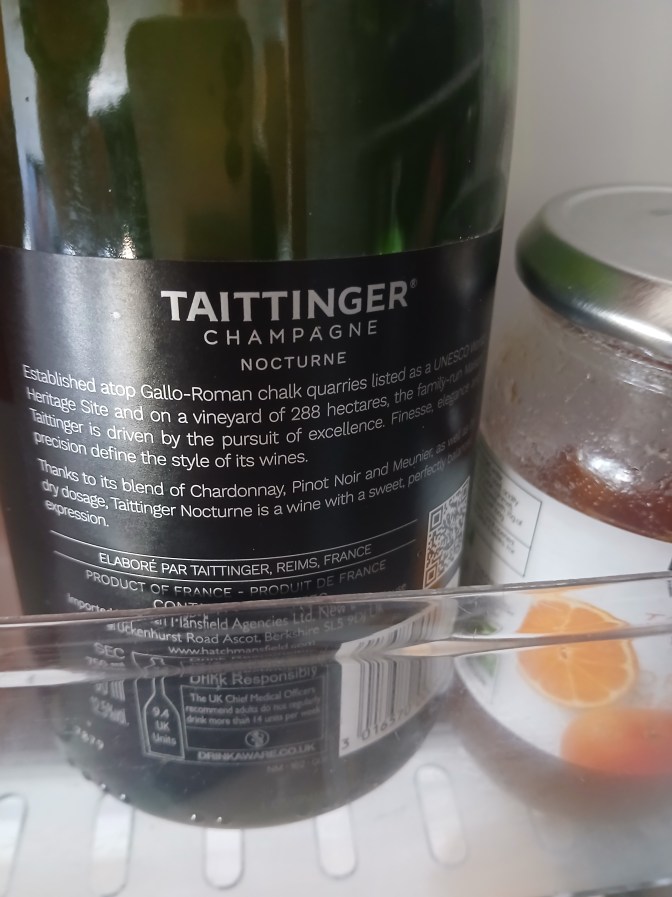
According to the label, Tattinger does most of its grape-growing in chalk quarries; much like the local ale, the wine benefits from this and develops a crisp bouquet that is hard to match in other terroirs. I’m not supposed to drink any. I’ll cook with it, though, and pour it for others.
Perhaps I’ll sip a little, and think back to the song of those linnets, and other more essential memories.


Gareth, wonderful and new beginning? I hope so! John & Sue
LikeLike
Hello John! So good to hear from you. I just emailed you, to say I’ve published a blog/was busily removing typos- all gone now, I hope? Yes- a new start! Will be in touch, soon- I hope you’re both well- Please give my best to Sue x
LikeLike
Thank you Gareth, I always enjoy reading your blogs. I’m sorry to hear of your health problems – I hope it won’t affect you too much. Dodgy knees have curtailed my chalkstream fishing and reading this has reminded me that perhaps I should now target the Bass myself!
Best wishes
Neil Rogers
LikeLiked by 1 person
Hello Neil,
Lovely to hear from you- Yes, absolutely get after those bass! They’re a reliable quarry in southern England, and knee-wise, you can easily bait fish for them.
Lure fishing means a lot of walking/wading on rocky ground. I adore it, but bait fishing is kinder on the knees- and it’s brilliant- I should have done more of it, this season. The bass have been in since April, but rather than dusting my beachcaster off, I’ve been waiting for clear conditions, so I can get out and lure fish. Bait takes the bigger fish, too, so yes- get out there and let me know how you get on, Neil!
I did some chalk stream trouting in April- took some lovely wild fish- one of them was marked like a leopard.
Let me know how you get on-
God Bless and Speak Soon,
Gareth Craddock
LikeLike
Beautiful. Just beautiful. What a surprise to read at breakfast your informative and utterly charming words about our land and sea and to actually hear the unapologetic cry of the lonesome linnet! I enjoyed every word and will spend the day pondering the wildly feasting bass as I walk above them on the way ro Pegwell. Many thanks for sharing your knowledge in such a heartwarming fashion, Gareth. You made my day.
Fondly
Sarah Simpson-Enock
LikeLiked by 1 person
Hello Sarah- What a beautiful comment!- I’d say you’ve rather made my day, too.
You’re a fellow of the chalk, I see?- We’re lucky to live in such a lovely part of England, aren’t we?
Thank you for reading- I hope the linnets bless your path, today- Gareth Craddock x
LikeLike
What a lovely blog this is Gareth, thank you.
LikeLiked by 1 person
Hello Sarah,
Lovely to hear from you and thanks for such a lovely comment.
I’m so glad you enjoyed it; I’m a huge fan of your poetry. I also appreciate a fellow wordsmith who’s fallen for this patch of ours. We’re lucky to live here, aren’t we? Wild cliffs, migratory wild visitors- and surrounded by Victoriana (pubs, houses, parks)… Lots for us to to muse on.
Very Best Wishes, Gazza
LikeLike
Yes indeed lucky to live here – the older I get the more I value our unique corner, and realise what a gift it is for any poet or writer interested in landscape and place. I used to enjoy reading your blog pieces before – seems like a long while ago – glad to see you’ve returned to it. 🙂
LikeLiked by 1 person
Thank you, Sarah! I went to an interesting little place today. In the first instance, I’d gone to Westwood Cross; once there, I did my shopping and then took a walk. I walked up and through the parkland at Jackey Bakers. Not been there in a long time.
Anyhow, I found a wood that I’d long forgotten about: in the south-east corner of the common ground, near to the allotments. I wandered in there for about an hour and found speckled wood butterflies, long tailed tits and the original iron fencing that used to delineate the former estate.
Amazing little find. Any woodland in Thanet is highly prized, so I’ll be looking in on this patch from time to time, to see how it gets on x
LikeLike
Love this Gareth, what a lovely find. I haven’t been near there for years either….but I do find aimless wanderings around this island of ours does sometimes yield unexpected delights….I expect another blog in due course please. 🙂
LikeLiked by 1 person
You can count on it, Sarah!… Perhaps even a little something about those woods? x
LikeLiked by 1 person
A beautifully written piece from a wonderful writer, Gareth has a way with words that pull you into his stories and places you right in the heart of them that you can almost smell the sea.
If you liked that he’s had a brilliant book published in 2024 called Forgotten Fen (Postcards from a Kentish Angler) which is a beautiful little book that you don’t have to be a fisherman to enjoy.
I’m very proud to call Gareth a bestie and I’m very proud of him like all of his friends and family are, then again I don’t get bloody invites to Bass and Champagne Dinners 😆, I’ll make do with Midnight Run, cans of Cherry Pepsi and Belly Laughs.
LikeLiked by 1 person
Hello Stuart!
Consider yourself invited to the next Bass & Champagne Soirée, old friend!- This last one was merely the warm-up; the ‘dry run’. The best of the bass has been fresh frozen and is just for you (!)
What a generous comment to leave, old mate. More ‘Midnight Run’ soon, surely? And the bass!
I’ll be over to see you in the next few days; I have a copy of my book for ‘SpellBound’, the bookshop in Sandwich. I’ll call in and buy you a beer.
See you shortly, mate- and thanks so much for such a lovely comment. I’m so glad you enjoyed this entry,
Yours, Gazza
LikeLike